









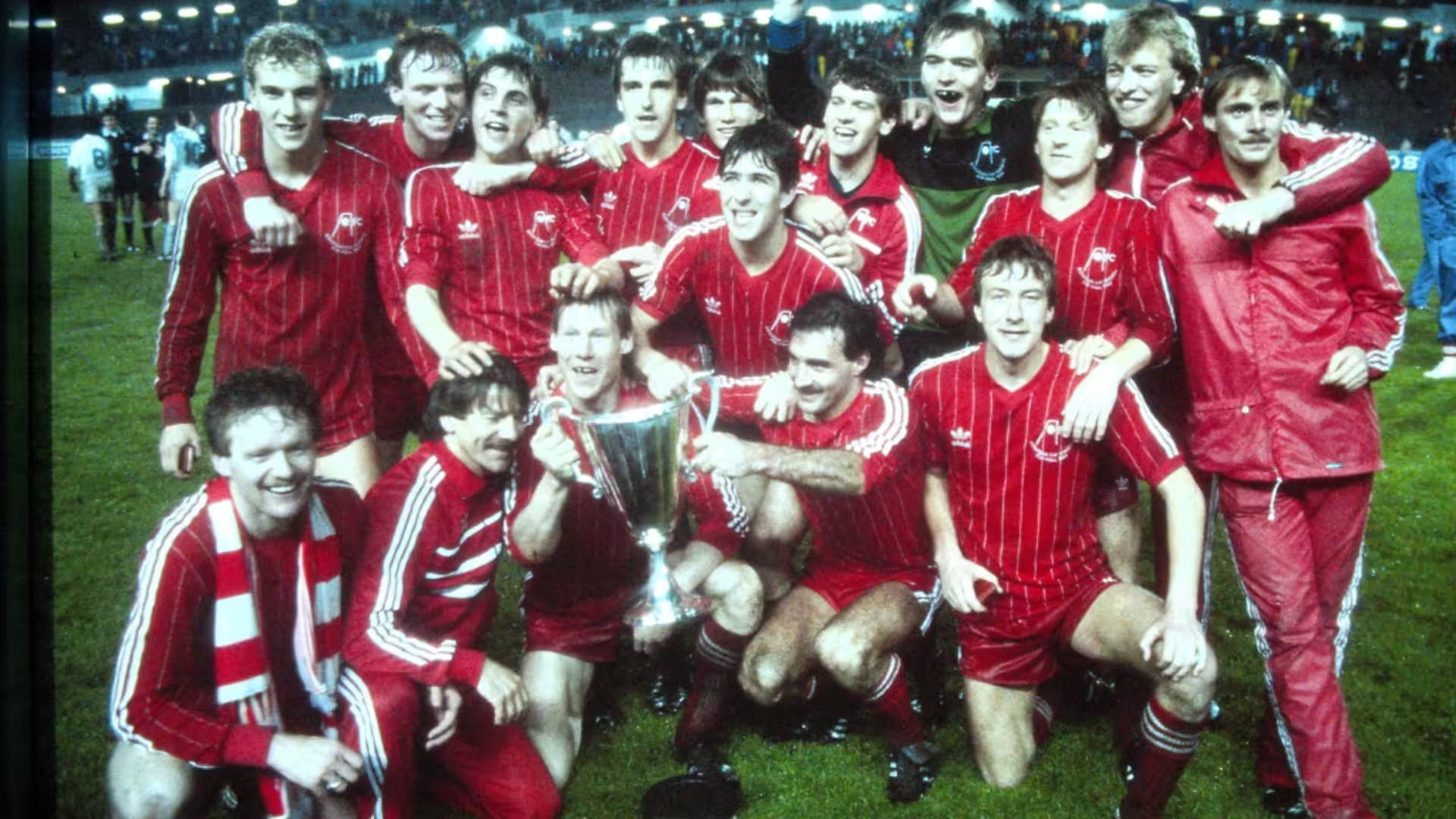
The UEFA Champions League has undergone a fundamental structural change since its inception. Originally designed as a knockout tournament in which only the actual champions of each country could participate, it was built solely on the merit of winning.
Today, the format has been re-engineered to prioritise the continued involvement of major clubs. The intention behind this was to ensure that high-revenue Super-Clubs like Real Madrid remain in the competition for as long as possible.
Therefore, in this article, we aim to make fans aware of a few realities.
- First of all, how did the early era of Real Madrid build on only winning with pure intentions?
- What happened to it later? Was it a business decision?
- And finally, how do modern rules protect big brands from early exit?
The Modern Champions League Has Changed Priorities
The Champions League is the biggest club competition in the world, but its original soul was very different from the TV product we see today. In the beginning, it was a brutal, ‘win-or-go-home’ tournament for actual champions. The newer version today just protects the richest clubs and ensures they stay on our screens as long as possible.
We are really moving away from the drama of the underdog and toward a guaranteed business model for the elite. If you are reading this, congratulations! You are amongst those few loyal football fans who somehow still care about the game and how it is being ruined for profits.
Originally, It Used to be A Tournament Only for Winners
When the competition began in the 1950s (then known as the European Cup), the rules were incredibly simple. The teams had to win their domestic league to enter.
There were no second chances. No safety nets and no ‘group stages’ to fix a bad performance. This clearly told the players and clubs that if you lose a game, you will likely be out. Real Madrid dominated this early era, winning the first five trophies.
This success was built on a structure of absolute merit. After all, back then, the tournament didn’t care about market share or television ratings. The only aspects that mattered to it were finding the best team in Europe through a direct, high-stakes knockout format.
It was basically like challenging the #1 employee from every company. That too, with a condition that one bad day can get them fired instantly. Entirely focused on the sporting result of the 90 minutes on the pitch.
THIS IS THE ORIGINAL CHAMPIONS LEAGUE!
BRUTAL. UNPREDICTABLE.
Clubs Started Worrying About Financial Security
As we moved into the late 1980s, the structure of the game had already begun changing. Such that, the biggest clubs in Europe realised ‘Knockout Only’ format was a massive financial risk.
If a global brand like Real Madrid or AC Milan had one bad night and got knocked out in September, they could lose out on months of ticket sales and television money. This led to the rebranding of the competition in 1992.
Under this umbrella, this history of European Champion Clubs’ Cup got its new name: the Union of European Football Associations (UEFA) Champions League.
Some people would also refer to it as the European Cup. The change in name was ironic because, shortly after, they began allowing teams that hadn’t won their leagues to enter. The reason behind this move was to allow the top teams from the richest countries to enter.
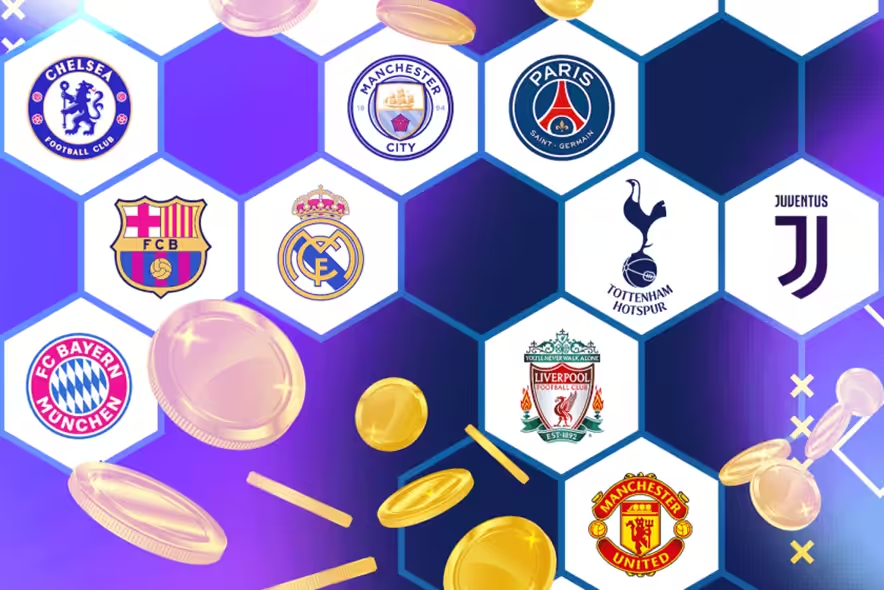
After all, teams with the most fans meant more and more money! Clearly, the priorities were shifting. The clubs were no longer worried about finding the best players. Instead, they were now eager only to make sure that the best brands were always on the screen.
The Group Stages as a Corporate Safety Net
Moving on, the most important structural change to understand is the group stage. Unlike older days when every game was a ‘win or go home’ situation, now the first half of the tournament is a mini-league. This is basically just a safety net for wealthy clubs.
This means if a giant club like Real Madrid makes a mistake and loses their first game, they have five more games to fix it. However, this structure made it mathematically very difficult for a small, poor team to pull off an upset.
Over six games, the team with the most expensive players will almost always rise to the top. This was an intentional design choice to remove the unpredictability of sport, because unpredictability is bad for television advertisers who want to know for certain who is playing.
Snapshot of the Major Differences
| Feature | The Original European Cup | The Modern Champions League |
| Participant Criteria | Winners only | Top 4-5 bigger clubs |
| Unpredictability | High (any team could lose) | Low (wealthy teams are protected) |
| Television Value | Secondary to the sport | The primary driver of all rules |
| Number of Games | 7 to 9 to win | 15 to 17 to win |
Real Madrid, as The Master of Both Eras
Real Madrid, based in Madrid, Spain, is the perfect case study because it has succeeded in both original and recent systems. In the previous era, they won because they had the best players.
Then, in the profit and product first era, they still win because the structure of the competition perfectly matches their business model. Best for them, but unfair to others! Overall speaking, today, Real Madrid is a global media company as much as it is a football team.
Simply put, the Champions League is like a stage where players perform for the world. In it, big clubs, like Real Madrid, can use their history to pressure UEFA and hint that they could leave and start their own ‘Super League’ if their interests aren’t protected.
This is the biggest reason why the tournament keeps growing in the direction where more matches mean more TV time for the big teams, and more money for everyone involved.
Here is Yet Another Major Plot-Twist
In 2024, the tournament changed again to a ‘League Phase’ (often called the Swiss Model). Based on the details shared, instead of the traditional four-team groups, all clubs will now compete in one giant league table. This is an assurance that there are going to be more matches between the biggest clubs earlier in the season.
UEFA made this change to attract larger audiences and boost revenue by using the blockbuster matches as bait for the fans. It is yet another proof that business priorities are still defining the competition. More games mean more TV exposure, which typically means more money.
Conclusion
The Champions League is no longer just a trophy. If you have read the article so far, you will agree with Author Kristian Russell that it has now become a financial ecosystem designed for survival. The massive shift from the original winning-only format to the modern participation-first structure is proof of the 2026 corporate reality. Moreover, Real Madrid’s journey through history shows that, while the medals still look the same, the reasons for the tournament have changed.
All in all, the original spirit of the game and the modern commercial structure are poles apart. This is the reason why the team’s success is now measured by how long you can stay on the television screen, rather than just being the last team standing.