
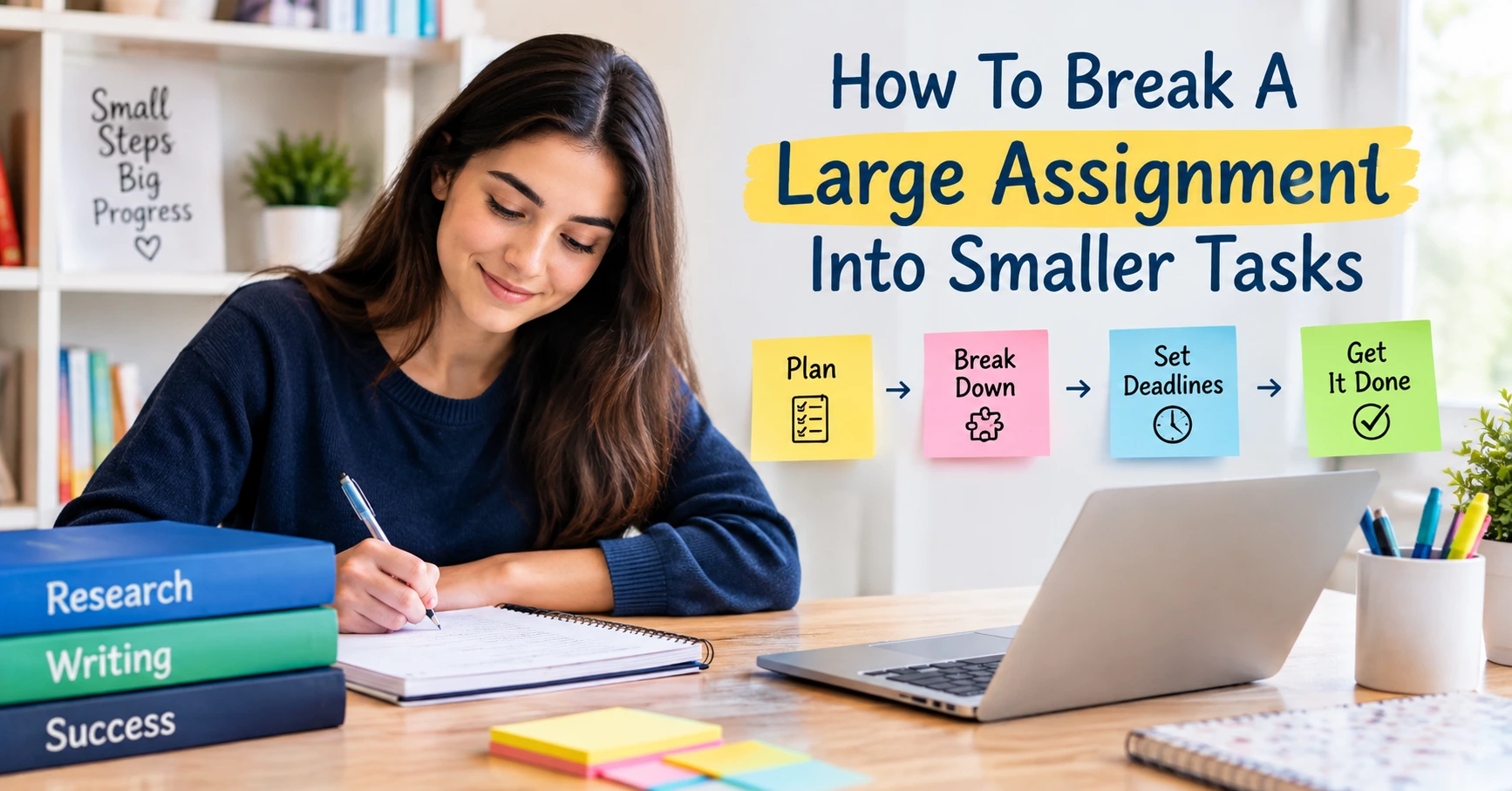








It may feel like a simple request to ask to do my assignment until you actually open the brief and see five pages of instructions, a word count, several research requirements, references and a deadline staring back at you. The problem usually is not that the assignment is impossible, but it is that your brain sees one enormous job instead of several manageable ones.
It can change when you break the work into smaller tasks. A 3,000-word report can be broken into research, outlining, drafting, editing, referencing and proofreading. Each part has its clear finish line. Research also supports the idea: a recent meta-analysis has found a moderate positive relationship between time management and learning outcomes of college students.
Why Does A Large Assignment Feel So Overwhelming?
Before you learn the method, it will help to understand why a big academic task can trigger avoidance. When the starting point is unclear, even motivated students can keep postponing the work.
● The Assignment Is Actually Several Jobs
A major paper does not always involve just writing. You may need to interpret the question, understand the material, write a draft, locate credible sources, develop an argument, organise sections, cite evidence and check formatting.
Treating all of that like one task can create unnecessary mental pressure. You can imagine being asked to clean the entire house, and that will sound exhausting. If they are broken down into tasks like cleaning the desk, organising a shelf, washing the dishes and vacuuming, it will feel much easier because each action has a visible boundary.
● Unclear Instructions Create Hidden Workload
You should read the assignment brief carefully before you create your schedule. It is better to look for the required word count, formatting rules, marking criteria, number or type of sources, learning objectives, submission format and exact question.
You should highlight command words such as analyse, evaluate, compare, discuss or critically assess. They can tell you what kind of response your lecturer will expect from you.
● Procrastination Makes The Assignment Appear Bigger
A recent study that was involving university students found that better planning, concentration, monitoring and lower procrastination were associated with stronger daily goal achievement.
This is also important because postponement does not make the workload disappear, and it can compress it into fewer days. It is better to break the workload into smaller actions to get a practical starting point if you are searching for do my assignment.
What Is The Best Way To Break An Assignment Into Steps?
The most effective approach that you can use is to move from the broadest view to the smallest useful action. You are not trying to create dozens of meaningless chores, and you are creating a sequence that can make progress obvious.
1. Decode The Assignment Question
You should begin with the question and write it at the top of a page, then underline the topic, limitations, action word and required outcome. For example, if the question asks you to compare two theories, your plan should contain research and discussion of both theories along with a direct comparison. This can help you prevent a common mistake: researching interesting information that can never actually answer the question.
2. Turn The Marking Criteria Into Tasks
The marking rubric is crucially a map of what earns marks. If there are any criteria for argument, structure, evidence, critical analysis and referencing, this will turn each one into something that you can work on. For example, critical analysis can become: identify opposing viewpoints, explain limitations, compare evidence and reach a justified judgment. This is far easier to act on than simply writing “make it analytical.”
3. Create A Simple Assignment Map
Before you start researching, you should sketch the likely structure. A typical essay may contain an introduction, a counterargument or evaluation section, three or four main discussion sections and a conclusion. You do not need to use perfect headings yet. Your goal is to give your research somewhere to go. Students often collect source after source without knowing which evidence actually belongs in the final paper.
4. Divide Research Into Questions
You should not make the research assignment your task. It is too broad. Instead, you should create research questions that are based on your planned sections. You can ask what you need to know about the central concept, what credible researchers disagree about, which evidence supports your argument and what limitations appear in the literature.
An assignment help company may also provide planning or feedback services for students who need structured academic guidance, but your own understanding of the brief should remain the foundation of the work. If you are considering whether to do my assignment independently, you should have a clear research plan to make the process more manageable.
5. Build A Source Collection System
You should record useful information immediately as you research. Must note the author, title, publication year, key finding, page number where relevant, and the section where you expect to use the source. This tiny habit will save you hours later. Must never assume that you will remember where a statistic or quotation came from, and you probably would not.
6. Make A Rough Outline Before Drafting
Now give every major section a purpose and under each heading, you need to write the point you want to establish, the evidence you might use and the explanation that connects that evidence to your argument. A useful paragraph pattern is simple: make the point, explain its significance, provide evidence, then connect it back to the question.
7. Draft Without Trying To Be Perfect
When you are done with your first draft, it is not supposed to sound finished.
You now write the argument when the ideas are fresh. If you cannot remember an exact citation, you must insert a clear placeholder and continue, and if you spend twenty minutes perfecting one sentence, you may lose momentum across the entire assignment. You should finish the rough version first and polish it later.
8. Edit For Argument, Not Just Grammar
Once your draft exists, you should read it as a marker would. Does every section answer the question? Are you explaining sources rather than merely describing them? Does the evidence actually support the claim? Are paragraphs connected logically? A grammar check can help you identify spelling errors, and it cannot decide whether your argument can make sense.
9. Check References And Formatting
You should leave dedicated time for the final technical check and compare every in-text citation with the reference list, check headings and page numbers, verify the required referencing style and confirm that the document meets the submission instructions. A planned final review can help you to prevent your own deadline from becoming the deciding factor.
10.Set Mini-Deadlines
Instead of one deadline, you should create several timeframes for yourself. For example, you finish research by Tuesday, complete an outline by Wednesday, create a first draft by Thursday, edit by Friday and make the final submission by Saturday. Mini-deadlines can create momentum and expose delays early enough to fix them. If one stage will take longer than expected, then you still have information about where your schedule needs to adjust.
How Can You Make The Process Easier?
Once you divide the assignment, the next challenge is to maintain momentum. Small practical changes can enable you to make the system much easier to follow.
● Use Time Blocks
You should choose a realistic period for one task instead of promising to study all afternoon. If you will have a focused 45-minute research session, it has a clearer purpose than an undefined three-hour study block.
● Separate Thinking From Polishing
Each part, including research, drafting and proofreading, requires different kinds of attention. You should avoid switching between them constantly and finish collecting your core evidence before you obsess over sentence-level improvements.
● Start With The Easiest Useful Task
When motivation is low, you should begin with something concrete: find two academic sources, write three paragraph ideas or create the outline. You need to start creating movement, and movement makes the next task easier.
● Leave A Buffer Before Submission
You should never make the official deadline your personal deadline. Technical problems can happen, a reference can need checking, and a paragraph can require rewriting. A submission portal can behave unexpectedly, and a buffer can give you room to respond instead of panicking.
Frequently Asked Questions
1. How early should I start to break down an assignment?
You should start as soon as you receive it. Even ten minutes you need to spend to identify requirements, estimate the workload and create mini-deadlines to prevent last-minute pressure. The earlier you identify research-heavy sections or unclear instructions, the more time you will have to solve them properly.
2. What if I cannot understand the assignment question?
You should not immediately begin to research. First, you should identify the command word and the subject being discussed. Then check your course materials, marking rubric and the guidance of the lecturers. If the expected meaning remains unclear, you can ask your instructor for clarification before you invest hours in the wrong direction.
3. How small should I consider individual tasks?
A task should ideally have a clear beginning and ending. “Research the essay”, this task may be too large, while “Find three peer-reviewed sources about X” is much better. If you can complete the action within one focused study session, then it is probably small enough to manage comfortably.
Final Verdict
A large assignment can become much less intimidating when you stop treating it like one enormous piece of work. You should decode the question, break the requirements into stages, research with purpose, outline before drafting and give every stage its own deadline. The goal is not to work harder for longer, but it is to make the next action obvious. Even demanding academic projects become easier to control once you build that habit. Before you decide to do my assignment, you should ask yourself whether breaking the work into smaller and manageable steps can make the entire process easier.