










Growth sounds exciting in meetings. In reality, it exposes every weak system inside a company, especially communication. When a business is small, the phone setup doesn’t need to be sophisticated. A few extensions. Maybe a basic VoIP line. People know who sits where. If a call is missed, someone shouts across the room and fixes it. That works until it doesn’t.
The moment teams expand, add departments, or start hiring remotely, the cracks show up. Calls bounce between people. Customers repeat themselves. Managers can’t figure out why response times are inconsistent. Everyone feels busy, but results don’t reflect the effort.
That’s usually the point where leadership starts looking seriously at an IP PBX system not because it’s trendy, but because the old way stops scaling.
The Real Problem Isn’t Call Volume, It’s Structure
Many growing organizations assume the issue is simply “more calls.” So they hire more agents.
But adding people to a messy structure only multiplies confusion. Without centralized control, calls are handled based on habit instead of logic. Someone transfers a call because they think another department handles it. That department transfers it back. Meanwhile, the customer is waiting, wondering if anyone actually owns their issue.
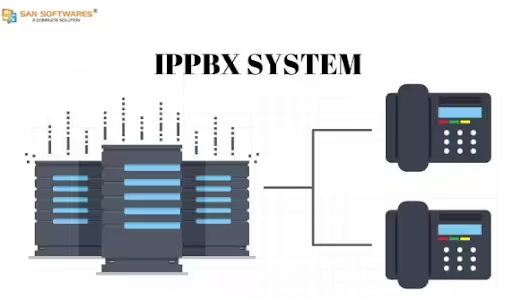
An IP PBX system changes this dynamic because it centralizes how calls are managed. Instead of depending on individuals to manually route calls correctly, the logic sits in the system itself. That shift from memory-based handling to rule-based handling is what supports growth.
Call Routing Becomes Strategic, Not Reactive
In smaller setups, call routing is usually basic. Phones ring in a fixed order. If someone is unavailable, it keeps ringing elsewhere. That might sound harmless, but as departments specialize, this approach becomes inefficient. Sales calls land in support. Support calls reach finance. Internal transfers increase. Call duration rises for the wrong reasons. This is where structured call routing software starts to matter.
Instead of random ringing, calls move based on predefined logic:
- Route new inquiries to sales first.
- Send technical issues directly to support.
- Prioritize repeat customers differently.
- Handle after-hours calls without manual intervention.
It’s not about complexity. It’s about predictability.
When routing becomes intentional, response times stabilize. Customers don’t feel like they’re navigating a maze.
Remote Work Changes the Equation
One of the biggest stress tests for traditional phone systems happens when organizations expand beyond a single physical office. Hiring talent in different cities. Supporting hybrid schedules. Expanding across regions. Old PBX setups tie extensions to physical desks. Moving someone means rewiring or hardware changes. Scaling becomes expensive and slow.
An IP PBX system removes that physical limitation. Extensions aren’t locations they’re configurations. An employee in another city can function exactly like someone in the head office.
For growing organizations, this flexibility isn’t optional anymore. It’s operational stability.
Visibility Becomes a Management Tool
Growth introduces another challenge: leadership loses direct visibility.
When teams were small, managers could hear phones ringing. They knew when things were hectic. Now, with multiple departments and remote staff, that awareness disappears.
An IP PBX system brings that visibility back in data form.
Managers can see:
- Active calls
- Missed calls
- Call duration patterns
- Peak traffic times
This isn’t about micromanagement. It’s about awareness.
Without visibility, decisions are reactive. With visibility, teams can adjust before service quality drops.
Efficiency Isn’t About Speed It’s About Flow
Growing organizations often focus on answering calls faster. But speed alone doesn’t solve inefficiency. What really improves performance is flow. When inbound calls, internal transfers, and outbound follow-ups are handled within a coordinated structure, agents stop wasting time on manual processes. They don’t guess who should take a call. They don’t repeatedly redial numbers unnecessarily. They don’t sit idle while another department is overloaded. Call routing software inside an IP PBX system helps create that balance. Calls move where they should. Workloads distribute more evenly. Pressure reduces during peak hours because the system absorbs part of the complexity. It’s subtle, but over weeks and months, the difference shows up in morale and customer experience.
Scaling Without Rebuilding Everything
Another overlooked benefit of an IP PBX system is how it handles incremental growth.
Hiring five new agents shouldn’t require rebuilding the entire phone infrastructure. Opening a new branch shouldn’t mean installing another isolated system.
Because IP PBX operates through network infrastructure, expansion becomes configuration instead of construction. Add users. Adjust routing rules. Update extensions.
For organizations planning long-term growth, this adaptability prevents constant technical overhauls.
What Leaders Notice After Implementation
Interestingly, when companies transition to a structured IP PBX environment, the improvements feel practical rather than dramatic. Fewer complaints about being transferred repeatedly.
More consistent response times across departments. Smoother onboarding for new hires because the call structure already exists. Remote employees integrating seamlessly into the communication workflow. No one throws a celebration over routing logic. But operational friction decreases. And in growing organizations, reducing friction is often more valuable than flashy upgrades.
Systems Should Support People Not Burden Them
It’s easy to blame teams when communication breaks down. But in many cases, people are compensating for weak systems.An IP PBX system doesn’t replace human skill. It removes avoidable chaos.When call routing software handles distribution intelligently, employees focus on conversations instead of logistics. Managers focus on improvement instead of damage control. Growth will always introduce complexity. The difference lies in whether that complexity is managed intentionally or left to chance.
Organizations that scale successfully tend to standardize their communication infrastructure early. Not because they anticipate problems but because they understand that systems must evolve alongside ambition.
And communication, more than almost anything else, determines whether growth feels controlled or overwhelming.