










Every online seller knows the moment: it’s Wednesday morning, you’ve got 200 orders from yesterday, and your team is staring at a mountain of packages that need to go out before noon. Your courier’s portal is open. Your spreadsheet is open. Your store’s backend is open. And you’re still doing the math by hand — which carrier is cheapest for this zone, does BlueDart cover that pincode, what’s the current rate for 2kg to Bangalore?
That’s not shipping. That’s chaos with a deadline.
The problem isn’t that shipping is hard. The problem is that shipping solutions for ecommerce still treat every order like an individual puzzle. Most sellers, especially when they’re growing fast, don’t have time for that. They need a system that takes the puzzle apart for them.
So what does a real shipping solution actually do?
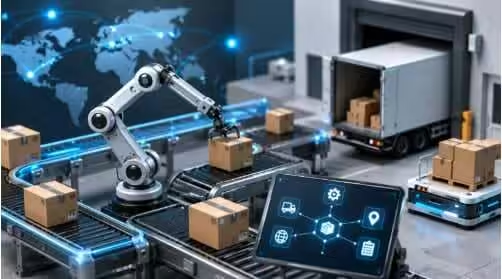
It connects your store to your couriers. Not manually — automatically. The moment a customer orders on your Shopify store or buys on Amazon, that order lands in your shipping system. No downloading sheets, no copying details, no typing. Just sync.
It picks the right courier for each order. And here’s the thing most sellers get wrong — the cheapest courier isn’t always the right one. A carrier that’s $50 cheaper for one zone might be slow or unreliable in another. A real solution checks all of that. Rate, delivery speed, pincode coverage, past performance — all at once. Then it assigns the courier that actually fits that specific order.
It prints labels without anyone having to ask. Labels generate automatically. Your team doesn’t sit at a printer hitting refresh. They pack. The labels are already there.
It keeps your customers updated. Tracking links go out. Delivery updates flow in. Customers stop calling asking where their order is because they already know.
It handles the hard stuff. When a delivery fails, the system flags it before it becomes a full return. When COD comes in, it reconciles across every courier automatically. When a customer wants to return something, the reverse pickup is booked from the same screen.
The shipping solutions that actually work do all of this. And here’s what’s tricky — not all of them do it the same way, and not all of them actually solve the India-specific part.
See, if you’re selling online in India, you’re not just shipping. You’re handling COD (cash on delivery), which is still how a huge percentage of orders happen here. You’re routing around pincode gaps that international carriers have no idea exist. You’re managing NDRs (non-delivery reports) and RTOs (return-to-origin) that international software treats like edge cases, even though they’re central to your business. You’re working with couriers like Delhivery, BlueDart, Ecom Express, and XpressBees — not FedEx and UPS.
A shipping solution built for India knows all of this. It’s built around how your business actually works.
What should you actually look for in a shipping solution?
First, does it connect to the couriers you’re already using? If you’re locked into a system that only works with two carriers and you need eight, that’s not a solution — that’s a bottleneck.
Second, can your team actually use it? If shipping software requires a developer to set up or takes two weeks of training, it’s too heavy. You need something that works in minutes.
Third, does it cut your actual costs? Not theoretically — actually. If a platform says it’ll save you money but the math doesn’t work for your order mix, it won’t.
Fourth, does it lower your RTO? This is the one nobody talks about until it’s eating 15% of their margin. A good shipping solution catches failed deliveries early and routes orders intelligently so fewer come back.
Fifth, can it scale? You’re growing. Your solution can’t be something that breaks when you hit 1,000 orders a day.
The sellers who’ve figured this out aren’t using six different tools. They’re not logging into courier portals every morning. They’re using a shipping solution that takes the whole chain — order to doorstep, including returns — and runs it automatically.
That’s the difference between managing shipping and scaling a business. One takes three hours a day and a spreadsheet that never balances. The other is a system that just works.
If you’re tired of the manual part, the good news is there are solutions now that actually handle the way ecommerce shipping works — especially in India. It’s worth looking at what’s out there. Your team will thank you, and your margin will show it.
Learn more about ecommerce shipping solutions at shipra.org.