










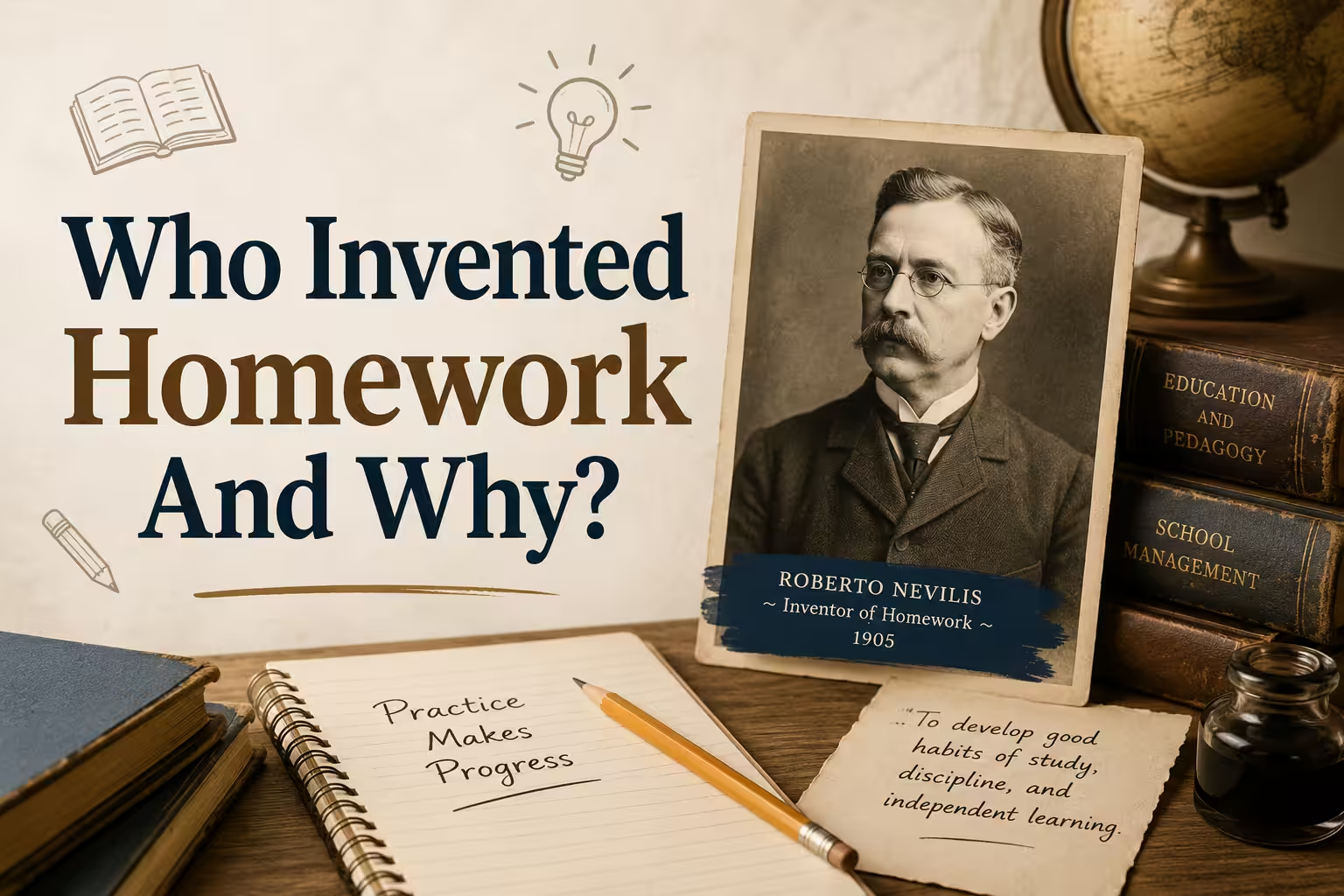
Do you get stressed from late-night studies and wonder who created this whole process? Find out who invented homework and for what reason it was developed by educational reformers.
Exploring the Real Reasons Homework Was Introduced
For years, students, teachers, and education experts have been debating the question, Who Invented Homework and Why?
Homework is a common feature of education worldwide, but few people reflect on its origins or purpose.
There is no single universally accepted inventor of homework, but evidence from history indicates that the idea of homework assignments outside the classroom gradually developed over the course of time.
Investigate the origin of homework through an examination of the history of education, teaching styles, and evolving educational needs.
In examining its origins, we can gain insight into why homework continues to play a crucial role in the contemporary educational environment.
Understanding Where The Homework Concept Began
While looking into Who Invented Homework And Why, numerous sources reference an Italian teacher from the early 20th century named Roberto Nevilis. He is said to have started homework as an aid to learning and to foster discipline among students.
But historians have found little evidence in support of the idea that homework was designed by one particular person.
In fact, there were educational methods of independent work before Nevilis.
Students were encouraged to continue their learning beyond the classroom in the spirit of the ancient civilizations, such as Greece and Rome.
Homework is not one invention, but rather a process that evolved as teachers realized there was benefit to practicing and learning outside of the classroom.
What Is The Original Purpose Of Student Assignments?
To understand Who Invented Homework And Why, it is important to explore the purpose homework originally served.
Early educators thought repetition and reinforcement were essential to learning. Concepts were introduced during classroom instruction, and activities were assigned at home to aid in the recall and application of these concepts.
Homework was planned to:
- Enhance learning lessons
- Encourage independent thinking
- Ensure discipline and responsibility
- Provide additional practice opportunities
The intent was not just to fill students’ time after school. Homework was considered a means to further learning outside class.
How Homework Has Changed Over The Centuries
Homework has evolved over the years. In the past, students were usually required to reproduce texts, perform calculations, or to remember information.
Homework became more formalized as schools became more structured in the 19th and 20th centuries. Specific tasks were set that were directly related to the classroom work.
Various approaches were taken by different countries. Some schools adopted the large homework approach, while others favored lighter workloads and more creative, practical learning.
As the demands on education continue to rise and education becomes increasingly global, the role of homework has become greater.
Developing Effective Study Skills Through Independent Study
Homework was popular because it fostered independent learning styles.
Students who work outside the classroom may acquire the following skills:
- Time management
- Self-discipline
- Problem-solving
- Personal accountability
Skills are not only important for studying but also in the workplace. Educators realized that education is not something that happens only during the school day.
Homework provides students with opportunities to learn at their own pace. This extra exposure can enhance comprehension and indicate additional areas to explore.
Academic Support For Modern Education
The needs of education have grown substantially, and many students are asking for more educational assistance.
Homework Help is used by many learners when they need more information about complex concepts or support with their complex assignments. These services can be used to guide and to help students to understand some difficult topics.
Learning is not the aim of educational support services. Rather, they are used as aids to develop confidence and academic abilities.
This aligns with the larger trend of Education, which takes learning support beyond the classroom.
Supporting Classroom Learning Beyond School Hours
Homework extends learning opportunities beyond the classroom. Teachers have to deal with constraints on what can be covered during lessons.
Homework can be used to review, rehearse, and practice skills and concepts, and prepare for topics to be covered.
For example:
- Mathematics must be solved over and over again
- Reading and writing practice are helpful in language learning
- Science concepts are often best reviewed independently
These activities support the revision of knowledge taught in lessons
Who Invented Homework And Why is about knowing that teachers were looking for ways to get more learning done within the same amount of time as the school day.
The homework was a practical way of meeting this objective.
Examining Criticism And Concerns About Homework
Homework has been criticized since ancient times.
Some concerns include:
- Overwork resulting in stress
- Lowered family and leisure time
- Different opportunities to learn
- The potential effect on mental health
Some critics say that excessive homework can cause stress without enhancing student learning. Quality has been demonstrated to be more important than quantity in some cases.
Today’s education experts recommend more balanced assignments, which facilitate learning without overloading students.
The debate Who Invented Homework And Why continues, in part because there is still a division of opinion about the overall effect of homework on student development.
How Technology Has Affected Homework
The purpose of technology is to revolutionize the way that students finish their assignments.
Many learners use today:
- Digital learning platforms
- Educational videos
- Interactive exercises
- Virtual collaboration tools
These resources offer flexibility and access to information that earlier generations did not have.
The modern student can research on the spot, interact with others via the Internet, and submit assignments electronically.
Homework has been evolving over the years, adapting to technological changes. The aim is the same, but techniques are gradually improving.
For many students, technology has been a facilitator of learning on their own and keeping them engaged in their learning.
Supporting Learning Using Flexible Educational Resources
Today’s education provides a greater variety of learning media than ever before. Tutorials, practice tests, and dedicated support materials are available to help students to develop a better understanding.
Online Assignment Assistance platforms are used by many learners to seek further clarification, feedback, or study support in independent study situations.
With careful use, these resources can support classroom instruction and be used to overcome academic difficulties.
The provision of such support reflects the changing nature of education from traditional homework practices to a different approach that aims at improving students’ learning outcomes.
FAQs
Who came up with the idea of homework?
Roberto Nevilis is frequently connected with homework, although it is unclear whether he was the inventor of homework or not.
Why was homework introduced in schools?
Homework was added to enhance learning within the class, encourage practice, and develop responsibility and independent learning skills.
Is homework necessary in the 21st Century?
If homework is well-balanced and appropriately structured, it may be of assistance to improve understanding, reinforce concepts, and build good study habits.
Has homework been invented recently in schools?
Homework is not just a recent trend, but is also a part of education since ancient times.
Why did homework begin to become compulsory in the 19th century?
It shared the primary objectives of assisting with school instruction, maintaining discipline in the nation, and making the formal power of the school system directly available in the home.
Conclusion
The question of who invented homework is not a simple one to answer.
Roberto Nevilis is a familiar name when it comes to homework, and indeed, the process of devising homework has gone a long way in learning.
Since its inception, it has been used to summarize work, motivate self-directed learning, and offer out-of-classroom learning experiences.
Homework has evolved over the years, in response to the needs of the learner, the evolution of teaching and learning, and the impact of technology.
There is current debate over the effectiveness of homework; when carefully designed and managed, it is a worthwhile learning tool.
Understanding Who Invented Homework And Why equips us with the appreciation needed to support the ongoing changes in educational practices that enable students to grow.