









The International Baccalaureate (IB) Diploma Programme is widely recognized as one of the most challenging pre-university pathways in the world. It doesn’t just test your ability to memorize facts for a final exam. Instead, the IB focuses heavily on independent research and critical thinking.
At the very heart of this rigorous framework is the Internal Assessment, commonly known as the IA. The IA is a source of significant academic stress for most of the students. However, it becomes your best opportunity to secure top marks when approached with the help of IB writers, a clear strategy, and a simple, structured workflow.
But how to bring a positive influence of these assessments on your grade? Keep reading to find out.
What Exactly is an IB Internal Assessment?
An Internal Assessment is an independent research project that you must complete for almost every subject you take in the IB Diploma Programme. Unlike final exams, which are graded externally by IB examiners, your IA is initially graded by your own classroom teacher using strict IB rubrics.
A sample of these papers is then sent to the IB organization to be moderated, which ensures grading fairness worldwide.
Most of the students choose to buy internal assessment to:
- Get guidance from trained IB tutors
- Have professional support at each step
- Know about the most effective methods of data collection
- Submit an assignment with proper formatting and referencing
- Manage time more effectively in their busy schedules
How Do Internal Assessments Contribute To The Final Grade?
The IA typically accounts for 20% to 30% of your final IB grade for a specific subject, depending on whether you take the course at Standard Level (SL) or Higher Level (HL).
Take a look at these common IA requirements across subjects:
1. Sciences (Biology, Chemistry, Physics)
A formal laboratory report based on a hands-on experiment or a deep database analysis.
Remember, you can always take help from IB writers if you are facing challenges in this subject!
2. Mathematics
A mathematical exploration where you apply complex formulas to a real-world scenario or hobby that interests you.
3. Individuals and Societies (History, Psychology, Economics)
A structured research essay or data commentary focusing on a specific historical event or a psychological study.
How To Score High In Internal Assessment?
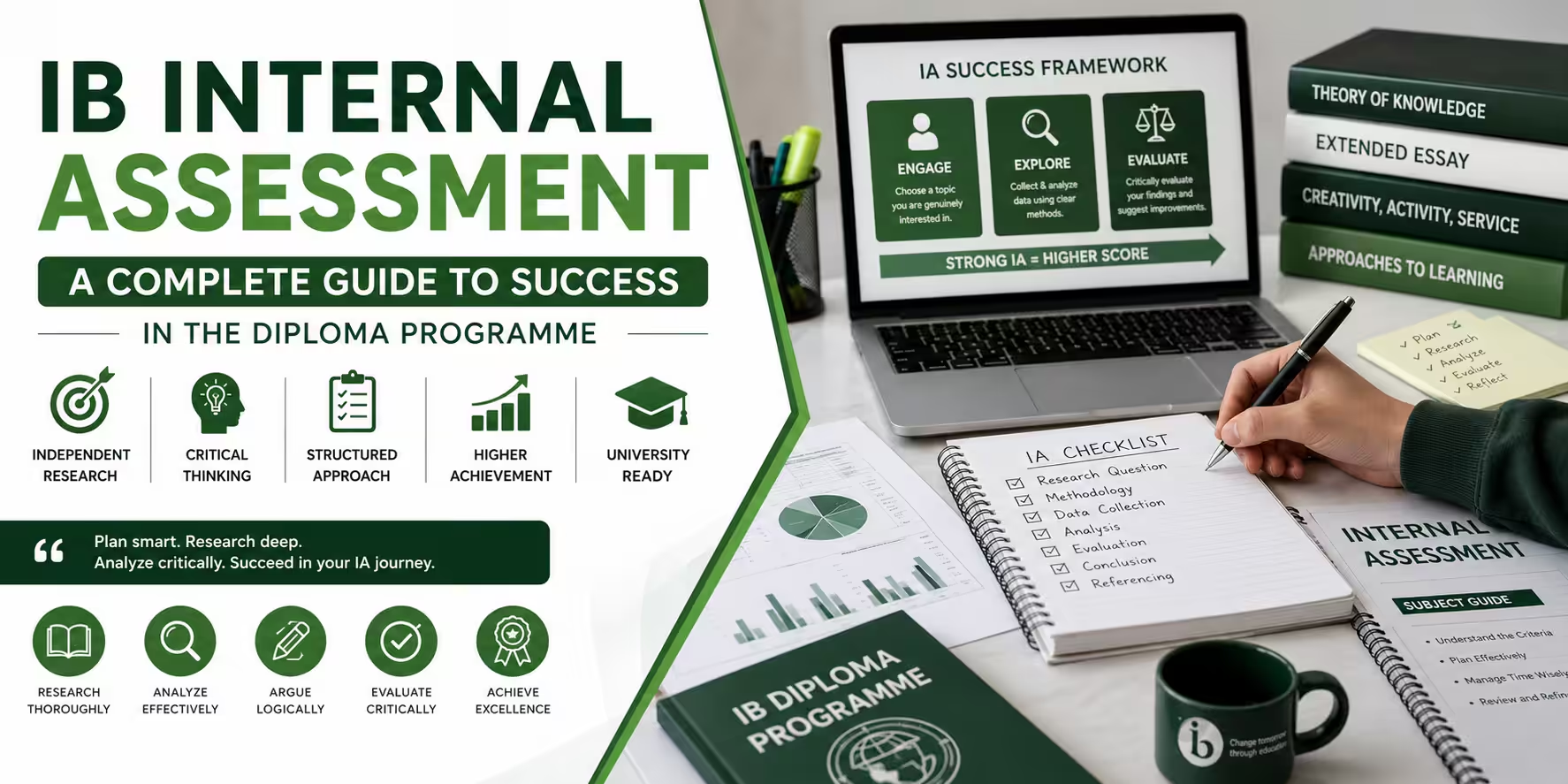
No matter what subject you are writing for, every top-tier IA relies on three core pillars. You are well on your way to the next level if your paper satisfies these three elements.
- Authentic Personal Engagement
The IB heavily penalizes dry, generic topics pulled straight from a textbook. The examiners want to see why you chose your specific research question.
Make sure to explain your personal connection to the topic while showing genuine intellectual curiosity right from the introduction.
- Clear Exploration and Analysis
This is the core body of your assignment. You must present your data, formulas, or historical evidence in a clean, highly structured format.
The best way is to explain your data with the help of:
- Scannable tables
- Clear graphs
- Direct paragraphs
Your analysis must move logically from one point to the next without leaving the reader confused.
- Critical Evaluation
The key is to critique your data. You must look at your research objectively in your evaluation section.
IB writers suggest that students should:
- Discuss the limitations of their methodology
- Identify potential sources of error
- Suggest realistic improvements for future studies
Acknowledging flaws in your work actually raises your academic score!
How to Synthesize Your Sources and Data In IB Internal Assessment?
Synthesizing your academic research means taking information from different journals or experimental trials and blending them together to back up your central thesis.
Many students overcomplicate this process. This creates a messy layout that reads like a random list of facts.
Follow this clean framework to keep your research synthesis structured and easy to read.
- Organize your paragraphs around specific arguments where multiple sources overlap
- Point out where different secondary sources yield the exact same results
- State conflicting perspectives and explain how it impacts your research question
- Connect your data points using simple phrases for a logical flow in your paper
- Tie every single piece of data back to your research question
How To Build An Undeniable Academic Argument In Internal Assessment?
Your IA is not a passive summary of a topic. It is an active defense of a specific position. Building a powerful argument does not require confusing jargon; it requires a transparent, step-by-step progression of logic.
Focus on these essential milestones to build a strong argument.
- Mention your main thesis in your introduction so the reader knows your target goal
- Every claim you make must be followed by a citation or a mathematical proof
- Explain to the reader how that data validates your thesis
- Briefly introduce counter-arguments to your data to show your academic maturity
- Prove why your core thesis remains logical despite those alternative viewpoints
FAQS
1) What happens if my IA goes over the official page or word limit?
The IB is incredibly strict regarding structural formatting boundaries. If you exceed these limits, the examiner will simply stop reading your paper the moment you cross the line, which can severely damage your final score. Make sure to check the word count before final submission.
2) How many sources should a standard IB Internal Assessment include?
There is no official minimum requirement for the sources. However, a standard humanities or social science IA should typically feature between 6 and 10 high-quality, credible sources in the bibliography. For experimental sciences, your bibliography may be slightly shorter, but it must still include the foundational textbooks and academic journals used to build your theoretical background.
3) How long should an IA be?
An IB Internal Assessment should generally be about 2200 words or 6 to 12 pages, which excludes the citations and appendices. However, you need to check your assignment guide as the exact word count depends on the subject you are writing for.
Wrapping Up
Tackling your IB Internal Assessments does not have to be overwhelming. The secret to success lies in choosing a topic you genuinely care about, structuring your arguments using simple language, and following a rigid logical progression suggested by professional IB writers. By focusing on the IB assignment criteria and prioritizing clarity, short sentences, and scannable layouts, you will make it incredibly easy for your teacher and the IB moderator to award you top marks.